
Understanding
digital violence.
Eight forms of technology-facilitated gender-based violence: definitions, warning signs and steps to take.
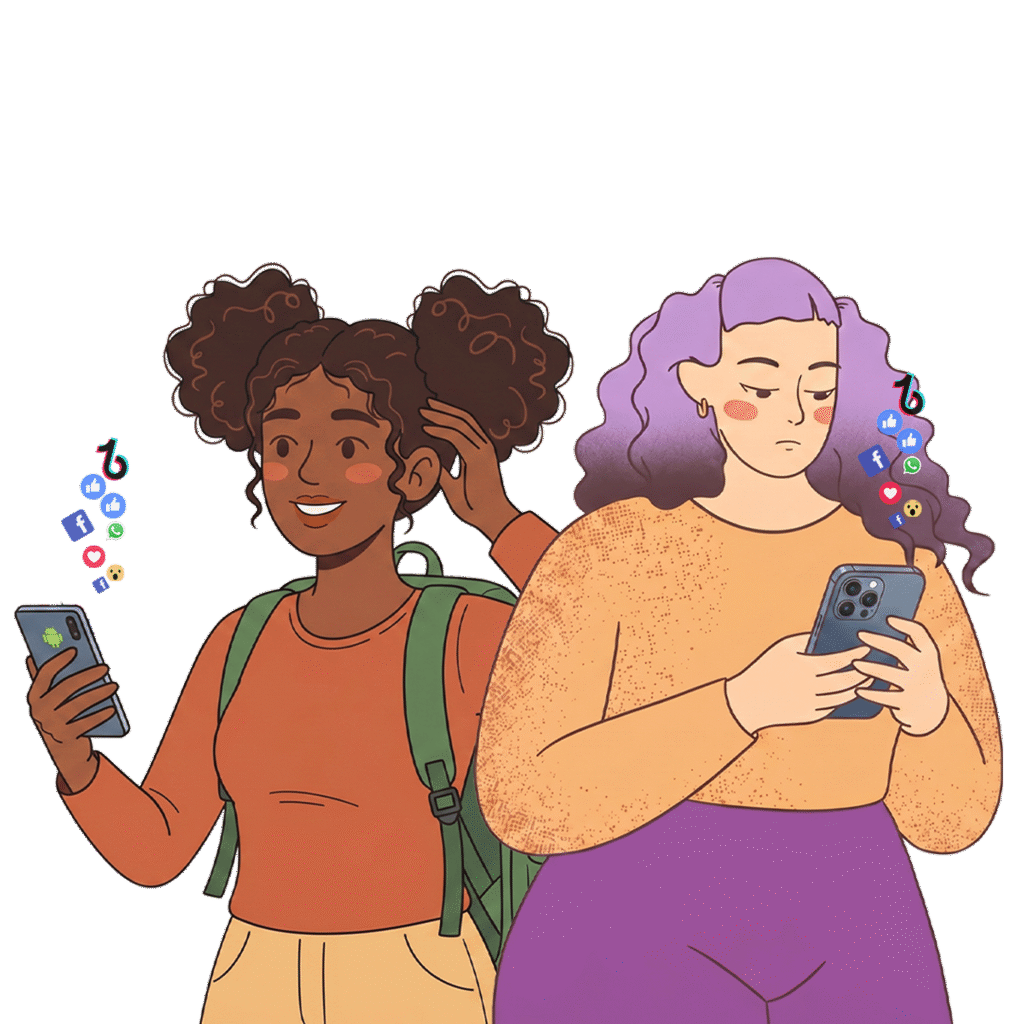
Recognise, respond, protect yourself
For each form of violence: an explanation, an example to decode, exercises and the steps to take. The “Read more” button opens a detailed section: causes, consequences, misconceptions, prevention and the legal framework.
Cyberharassment
Repeated messages, threats, humiliation or online surveillance to intimidate, control or harm someone. It is never “just the internet”: it is violence.
Cyberharassment means harming someone repeatedly using digital tools: messages, comments, posts, calls, edited photos. It can come from one person or from a group piling on (“pack” harassment), from a stranger or from someone close. Against women, it often targets the body, sexuality, reputation or speaking out in public.
Cyberharassment takes many forms: insults and mockery under your posts, constant private messages, calls from hidden numbers, rumours in WhatsApp groups, edited photos, pages or accounts created to mock you. What defines it is repetition and the intention to harm, intimidate or silence.
How it happens
- The triggerA post, a refusal, a break-up, an opinion shared online.
- The escalationRepeated messages, hurtful comments, fake accounts to get around being blocked.
- The exposureRumours, screenshots and photos shared in groups, in front of your loved ones.
- The isolationThe victim is afraid, withdraws from social media, loses confidence or opportunities.
Repeated acts
Insults, threats or mockery sent again and again, by one person or by a group.
Everywhere, at any time
It follows the victim on her phone: at home, at work, at night. It is hard to escape.
Often in front of others
Public comments, status updates, WhatsApp groups: the humiliation happens in front of your loved ones.
“You think you can ignore me? I know where you work. If you don’t answer me tonight, I’ll send your photos to your neighbourhood group.”
The harasser who watches you
Pressure, surveillance and threats
- He shows he is watching you (“I know where you work”)
- He threatens to expose you in front of your loved ones
- He demands an answer: he wants to control you
Warning signs to watch for
Unwanted messages
The same person keeps writing to you, even after a clear no.
Online surveillance
They comment on everything, know where you are, create accounts to follow you.
Humiliating post
Your photos or information are shared without your consent to harm you.
Exclusion and rumours
You are removed from groups, false stories are spread about you.
Practise
True or false?
Click your answer: the explanation appears.
Mocking comments posted by several different people can amount to cyberharassment.
this is “pack” harassment: each person writes only once, but together they harass the victim.
You should reply to the harasser to show you are not afraid.
replying often fuels the escalation. Keep the evidence, block and report.
A good screenshot shows the date, the account name and, if possible, the profile link.
these details allow the platform and investigators to identify the perpetrator.
A harasser is always a stranger.
the perpetrator is often an ex-partner, a colleague, a classmate or an acquaintance.
Role play
Choose the best response. You can try all the answers.
Since Aïcha posted a video about her sewing workshop, an anonymous account has been commenting on each of her posts with insults about her appearance, and messaging her privately at night.
What should she do first?
What to do?
- Don’t reply, don’t argue or negotiate with the perpetrator.
- Keep the evidence : screenshots with the date, account name, profile link. Before blocking or deleting anything.
- Block and report : Facebook, ··· menu → Report. WhatsApp: long press on the message → Report.
- Talk about it with someone you trust. You don’t have to face this alone.
- File a complaint and get support : with the police or the authority in charge of fighting cybercrime, and with a support service for victims of violence (helpline, association, social services).
Key points
- It is not your fault, and it is not “just the internet”.
- Evidence first, then blocking and reporting.
- You can file a complaint and get support.
Understand in detail
It particularly affects young women who are active online: students, entrepreneurs selling on Facebook or WhatsApp, content creators, activists. A post that “bothers” someone, a rejected advance or a break-up is often enough to trigger a wave of attacks.
Because it comes through the phone, it doesn’t stop in the evening or at the weekend: the victim carries it everywhere. That is why you need to act early, without waiting for the situation to get worse.
Why women are particularly targeted
Attacks on women rarely target their ideas: they go after their body, their clothes, their love life or their “respectability”. The aim is often to push them into silence or out of the online public space. This violence relies on gender stereotypes: that is why we speak of technology-facilitated gender-based violence (TF-GBV).
The consequences for victims
Mental health
Stress, anxiety, sleep problems, loss of self-confidence, sometimes isolation.
Working life
Lost customers, abandoned pages, opportunities turned down for fear of being exposed.
Relationships
Rumours among family, neighbours or at school, tension with loved ones.
Self-censorship
The victim posts less, hides, gives up sharing her opinion.
Who are the perpetrators?
Perpetrators are often people the victim knows: an ex-partner, a rejected suitor, a classmate, a colleague. But they can also be strangers acting in groups, protected by the anonymity of fake accounts.
Misconceptions: turn the cards over
Protect yourself beforehand
Who can comment
On Facebook and Instagram, limit comments on your public posts to your friends or followers.
Filter hurtful words
Instagram (Hidden Words) and TikTok (comment filter) automatically hide insults.
WhatsApp groups
Settings → Privacy → Groups → “My contacts”: strangers can no longer add you.
Your location
Avoid posting live where you are or the places you usually go (home, work, school).
What the law says
- Harassment committed electronically is punishable by law, just like offline harassment. More and more countries have specific laws on digital matters and on violence against women.
- Your remedies: file a complaint with the police or the authority in charge of fighting cybercrime, and get support from a service for victims of violence. Bring your evidence: screenshots, links, numbers, transaction references.
- On Digital Safe Space: you can report your situation confidentially to be directed to the right help.
Sextortion
Blackmail using intimate images to get money or more images. You are not to blame: the fault always lies with the perpetrator.
Sextortion is blackmail based on intimate images or videos, real or faked. The perpetrator threatens to share them to obtain money, more images, sexual acts, or to keep control over the victim. It may be an ex-partner, but also networks of scammers who target dozens of people with fake profiles.
Sextortion relies on shame and fear: the perpetrator knows the victim fears the judgement of her family, those around her or her employer, and uses this to demand more and more. The demands involve money (often via Mobile Money), new images, sexual acts or keeping up a relationship.
How it happens
- The contactAn attractive profile, often recent, showers you with compliments.
- The trustThe conversation moves very fast, goes private, onto WhatsApp or a video call.
- The imageHe asks for a photo, records the video call without you knowing or creates a fake.
- The blackmailThreats, a sum of money, a very short deadline. Then he asks again.
Trust comes first
The perpetrator builds a relationship by message, often with an attractive fake profile, and wins your trust.
The image obtained
A photo or video sent, a video call recorded without your knowledge, or even a fake.
The threat
He threatens to send everything to your family, your colleagues or into groups if you don’t pay. Then he asks again.
“I recorded our video call. If you don’t send me 100,000 FCFA before tonight, the video goes to your whole friends list and your family.”
Blackmail after a video call
Threat to share in exchange for money
- A very short deadline to make you panic
- He mentions your loved ones to scare you
- Paying erases nothing: he will come back for more
Practise
True or false?
Click your answer: the explanation appears.
Platforms can remove an intimate image published without your consent.
Facebook, Instagram, TikTok and WhatsApp have a specific reporting option for non-consensual intimate images.
Paying once puts an end to the blackmail.
paying shows that the blackmail works: the perpetrator almost always comes back with new demands.
You should delete the conversation so you no longer see the threats.
keep it: it is your evidence. You can archive it and mute notifications.
A video call can be recorded without your knowledge.
it is even the method most used by sextortion networks.
Role play
Choose the best response. You can try all the answers.
Rosine receives this message from an unknown account: “I have your video. 50,000 FCFA before 8 pm or I send it to your family.” She panics.
What is the best response?
What to do?
- Don’t pay and don’t send any more images. Giving in once shows that the blackmail works.
- Keep the evidence : threatening messages, the perpetrator’s profile, numbers, payment references requested.
- Block and report the account on the platform, in the “nudity” or “sharing intimate images” category.
- Have the content removed : platforms remove intimate images shared without consent. The free tool StopNCII.org also helps prevent them from spreading across several networks.
- File a complaint and get support : police or the authority in charge of cybercrime, a helpline or victim support association, legal support from a women’s rights association.
Key points
- You are not to blame: the fault lies with the person making the threats.
- Don’t pay, don’t negotiate, don’t send anything else.
- The content can be removed: act quickly and get help.
Understand in detail
Two situations are common. On the one hand, an ex-partner who keeps images shared in trust and threatens to publish them after a break-up. On the other, networks of scammers who create attractive fake profiles, obtain an image or record a video call, then blackmail dozens of people at once.
With artificial intelligence, it has also become possible to create fake intimate images from a simple profile picture. Even if the image is fake, the violence is real, and it is reported in the same way.
Why women are particularly targeted
Women face much harsher social judgement than men when an intimate image circulates. Perpetrators exploit this double standard: they count on shame to obtain silence and payment. Let’s be clear: the only person at fault is the one who threatens or shares.
The consequences for victims
Shock and fear
Panic, shame, a feeling of being trapped: talking about it quickly is essential.
Financial losses
Repeated payments that never put an end to the blackmail.
Isolation
Fear that family or friends will find out, withdrawal.
Distribution
If the images circulate, lasting damage to reputation: hence the importance of requesting removal quickly.
Who are the perpetrators?
Ex-partners and suitors, but also organised networks operating from abroad or from the sub-region, with fake profiles and several Mobile Money accounts.
Misconceptions: turn the cards over
Protect yourself beforehand
Camera and video calls
Refuse video calls from strangers and be wary of calls that come right after a first contact.
Stay unidentifiable
If you share an intimate image, avoid your face, tattoos, recognisable settings or objects.
Hidden friends list
Hide your friends list: it is what perpetrators use to threaten to send content to your loved ones.
Too-perfect profile
A recent, very attractive account that wants to move to private chat quickly: be careful.
What the law says
- Threatening to share or sharing intimate images without consent is an offence: it violates privacy and dignity. Whether the image is real or fake makes no difference.
- Removing content: filing a complaint and reporting to platforms make it possible to have the images deleted.
- Your remedies: file a complaint with the police or the authority in charge of fighting cybercrime, and get support from a service for victims of violence. Bring your evidence: screenshots, links, numbers, transaction references.
- On Digital Safe Space: you can report your situation confidentially to be directed to the right help.
Account hacking
Unauthorised access to your WhatsApp, Facebook or email to spy on you, steal your data or impersonate you.
Account hacking is when someone else takes control of your WhatsApp, Facebook, Instagram, TikTok or email. They can read your messages, copy your photos, write to your contacts in your name, ask them for money, or stop you from logging back in. In violence against women, it is often someone close who knows the phone’s passcode.
A hacked account is not just a technical problem: your private life, your conversations, your photos and your contact network end up in someone else’s hands. The hacker can use it to watch you, blackmail you or scam your loved ones in your name.
How it happens
- The accessSMS code obtained by trickery, fake link, guessed password or phone left unlocked.
- The lockoutHe changes the password and recovery email to lock you out.
- The exploitationHe reads your conversations, copies your photos and contacts.
- The abuseScamming your loved ones, blackmail, posts in your name.
The stolen SMS code
You are asked to “send back a code received by mistake”. That code is used to take over your WhatsApp.
The fake link
A page imitating Facebook or your email steals your password as soon as you type it.
The guessed password
Date of birth, first name, “123456” or the same password everywhere: one leak is all it takes.
The unlocked phone
A phone without a passcode, lent or left unlocked, or a spy app installed without your knowledge.
“Hi! I sent you a 6-digit code by SMS by mistake. Can you forward it to me please? It’s urgent.”
The fake code “sent by mistake”
WhatsApp account takeover
- This code is used to install YOUR WhatsApp on another phone
- Your contact’s account has probably already been hacked
- The urgency stops you from checking
Signs that your account has been hacked
Unknown login
A login alert from a device or a town you don’t recognise.
Messages sent without your knowledge
Your contacts receive messages or requests for money that you didn’t write.
Unable to log in
Your usual password no longer works: someone has changed it.
Code received for no reason
A verification code arrives even though you didn’t request anything.
Practise
True or false?
Click your answer: the explanation appears.
WhatsApp will never ask you to send your 6-digit code to anyone.
this code is only used to install WhatsApp on a phone. Whoever asks for it wants to take your account.
Using the same password everywhere is fine if it is long.
if just one website has its data stolen, all your accounts become accessible.
You can see the list of devices connected to your Facebook or Gmail account.
in the security settings, you can also log a device out remotely.
If a friend asks you for a code received by SMS, there is no risk.
her account has probably already been hacked: the hacker is using her name to take yours.
Role play
Choose the best response. You can try all the answers.
Mariam receives an alert: “New login to your account from an Android device.” She recognises neither the device nor the town shown.
What should she do?
Protect and recover your account
- Turn on two-step verification. WhatsApp: Settings → Account → Two-step verification. Facebook: Settings → Accounts Centre → Password and security.
- Check connected devices and log out any unknown device.
- Change the password : at least 12 characters, a different password for each account.
- Never share a code received by SMS or email, even with someone close to you.
- If the account has already been hacked : log back in to WhatsApp with your number, use facebook.com/hacked for Facebook, warn your contacts. If your SIM card no longer works, call your mobile operator right away.
Key points
- Never share a code received by SMS or email.
- Turn on two-step verification today.
- Unknown login = change the password and log the device out immediately.
Understand in detail
Most hacks require no particular skill: an SMS code obtained by trickery, a password that is too simple or reused, a fake login link, a phone left unlocked. That is good news: a few simple steps are enough to block most attacks.
In a couple, control also happens through the phone: demanding passcodes, reading messages, installing an app that tracks location or reads conversations. It is a form of violence, even without any “hacker” in the technical sense.
Why women are particularly targeted
Women are more often victims of someone close (partner, ex, family member) accessing their accounts to monitor their conversations, movements or friendships. Hacking then becomes a tool of control and jealousy.
The consequences for victims
Surveillance
Messages read, location tracked, friendships controlled.
Scamming loved ones
The hacker asks your contacts for money while pretending to be you.
Stolen photos
Private photos copied and then used to blackmail or humiliate.
Loss of access
Business account or sales page lost, along with all the customers.
Who are the perpetrators?
Scammers who steal WhatsApp accounts one after another, but also, very often, people close to you who know the phone’s passcode or have had access to the device.
Misconceptions: turn the cards over
Protect yourself beforehand
Locked phone
A code or fingerprint that nobody else knows, not even your partner.
Two steps everywhere
Two-step verification and a WhatsApp PIN: a stolen password is no longer enough.
Monthly check
Once a month, look at the devices connected to your accounts.
Safe apps
Only install apps from the Play Store or App Store, and remove unknown apps.
What the law says
- Accessing someone’s account or phone without permission is punishable by law, even when the perpetrator is a partner or a family member.
- Your remedies: file a complaint with the police or the authority in charge of fighting cybercrime, and get support from a service for victims of violence. Bring your evidence: screenshots, links, numbers, transaction references.
- On Digital Safe Space: you can report your situation confidentially to be directed to the right help.
Phishing
Fake texts, emails or links imitating a bank, a mobile operator or an official service to steal your login details, your codes or your money.
Phishing is a trap message (SMS, email, WhatsApp, call) pretending to be a bank, a Mobile Money operator, a public authority or a well-known brand. Its aim: to make you click, type in a code or send money. The messages are increasingly polished: no spelling mistakes, with logos and numbers that look like the real ones.
Phishing is the gateway to many other forms of violence: a password stolen through a fake link can then be used to hack an account, steal an identity or empty a Mobile Money account. Knowing how to recognise it protects you against many risks at once.
How it happens
- The baitAn urgent message or good news: account blocked, parcel, prize, refund.
- The clickThe link leads to a fake website, a perfect copy of the real one.
- The inputYou type in your password, your PIN or your SMS code.
- The theftThe account is emptied or hacked within minutes.
Artificial urgency
“Your account will be blocked in 24 hours”: they want you to act without thinking.
Suspicious link
An address with spelling mistakes, an unknown domain or a shortened link. That is not the real website.
Request for a code
No legitimate service asks for your PIN, your password or your SMS code.
Unexpected prize
“You have won 500,000 FCFA” without having entered anything: it’s a trap.
“Your Mobile Money account will be suspended in 24 hours. To keep it active, confirm your identity at this link and enter your PIN.”
The fake message from the operator
Theft of the Mobile Money PIN
- A threat of suspension with a short deadline
- A link that is not the operator’s official website
- You are asked for your PIN: no operator ever does this
Practise
True or false?
Click your answer: the explanation appears.
An operator may ask for your Mobile Money PIN by SMS.
no operator and no bank will ever ask for your PIN. Ever.
The address “momo-securite-compte.com” must be your operator’s official website.
anyone can buy a domain name that contains a brand name.
If in doubt, it is better to call the official number rather than the one given in the message.
the number in the message may belong to the scammer.
A message imposing a very short deadline (“within 24 hours”) is a warning sign.
urgency is used to stop you from thinking and checking.
Role play
Choose the best response. You can try all the answers.
Three texts arrive on Bénédicte’s phone on the same day.
Which one is most likely a scam?
What to do?
- Don’t click the link, even if the message seems to come from your bank or your operator.
- Report the message to the official customer service of your operator or bank, then delete it.
- If you clicked or gave a code : change your passwords immediately and call your bank or operator to block transactions.
- Turn on two-step verification on your accounts to limit the damage if a password is stolen.
Key points
- If in doubt, don’t click.
- No legitimate person will ask for your PIN.
- Check using the official number, never the one in the message.
Understand in detail
The most common messages imitate Mobile Money operators, banks, delivery services, recruiters, scholarships or competitions on social media. They arrive by SMS, WhatsApp, email or even by phone call.
Scammers work on their messages: official logos, a professional tone, numbers that look like the real ones. The only reliable reflex is never to act from the message itself, but to check through a channel you choose.
Why women are particularly targeted
Women entrepreneurs and students receive many targeted messages: fake funding reserved for women, fake scholarships, fake brand partnerships. These offers play on real needs to seem credible.
The consequences for victims
Money lost
Mobile Money or bank account emptied in a few minutes.
Hacked accounts
Stolen password, then takeover of your social media accounts.
Exposed data
Name, number, ID document reused for other scams.
Guilt
Shame at having clicked. Yet these traps are designed to fool everyone.
Who are the perpetrators?
Scam networks sending thousands of messages at once, hoping that a few people will click.
Misconceptions: turn the cards over
Protect yourself beforehand
Type the address yourself
For your bank or your email, use the official app or type the address yourself.
Secret codes are for you alone
PIN, password, SMS code: never give them to anyone, neither by message nor by phone.
Two steps
Two-step verification limits the damage if a password is stolen.
Phone up to date
Updates fix security holes used by hackers.
What the law says
- Online fraud, fraudulent collection of personal data and fraudulent access to accounts are punishable by law.
- Your remedies: file a complaint with the police or the authority in charge of fighting cybercrime, and get support from a service for victims of violence. Bring your evidence: screenshots, links, numbers, transaction references.
- On Digital Safe Space: you can report your situation confidentially to be directed to the right help.
Identity theft
Someone creates a fake profile with your name and photos to deceive your loved ones, ask for money or tarnish your reputation.
Online identity theft means using your name, your photos, your number or your documents to pretend to be you. The aim may be to scam your loved ones, ridicule you, publish sexual content in your name or damage your professional reputation.
Online identity theft can target your money, your reputation, or both. A fake profile in your name can ask your friends for money, publish shocking content, insult people in your name or sign you up to websites you have never visited.
How it happens
- The harvestingPublic photos, name, town, friends list taken from your profiles.
- The copyA fake profile almost identical to yours is created.
- The contactThe fake account adds your friends, your family, your customers.
- The abuseRequests for money, embarrassing messages, posts to tarnish your name.
A fake account in your image
Your photos and name copied on Facebook, Instagram or TikTok.
Requests for money in your name
The fake account writes to your contacts to ask them for money or codes.
Your data reused
Your name, number or documents are used to open accounts or deceive other people.
“Hi darling, this is my new account, the old one has a problem. Can you send me 20,000 FCFA by Mobile Money? I’ll pay you back tomorrow.”
The “new account”
A request for money in a friend’s name
- A “new account” with no clear explanation
- A request for money in the very first messages
- Few friends, photos copied from the old profile
Practise
True or false?
Click your answer: the explanation appears.
Facebook and Instagram offer a form to report a fake profile, even if you don’t have an account.
the identity theft form can be accessed from their help pages.
A friend’s “new account” asking for money should be checked with a phone call.
call her on her usual number before sending anything.
Online identity theft is not punishable by law.
it is an offence: you can file a complaint, with evidence.
Once the fake profile has been reported, there is no need to warn your contacts.
reporting can take time: your loved ones need to know right away that it is a fake.
Role play
Choose the best response. You can try all the answers.
A friend writes to you: “Your new account just asked me for 30,000 FCFA!” You haven’t created any new account.
What do you do?
What to do if someone is pretending to be you?
- Report the fake profile to the platform, in the “Pretending to be me” or “identity theft” category.
- Warn your contacts from your real account: the fake profile is not yours.
- Keep the evidence : link to the fake profile, screenshots of the photos and messages sent in your name.
- File a complaint : online identity theft is an offence. Contact the police or the authority in charge of cybercrime.
- Limit who sees your photos and your information: that is what is used to copy your profile.
Key points
- Report the fake profile and get your friends to report it.
- Warn your contacts from your real account.
- Any request for money by message should be checked with a phone call.
Understand in detail
For a woman entrepreneur, the damage is also commercial: a fake page copying your shop can take orders in your place and make your customers lose trust.
The hardest situations to live through are fake sexual profiles created with a woman’s photos to humiliate or harass her. They must be reported immediately and can be the subject of a complaint.
Why women are particularly targeted
Women’s photos are more often copied to create attractive fake profiles, later used in romance scams, or sexual accounts. The victim then suffers a double harm: to her image and to her reputation.
The consequences for victims
Loved ones scammed
Friends and family deceived by the fake account.
Damaged reputation
Words or images wrongly attributed to the victim.
Lost customers
A fake shop or fake page diverting orders.
Lengthy procedures
Reports, complaints, explanations to give to those around you.
Who are the perpetrators?
Scammers who recycle photos for their scams, but also harassers or ex-partners who want to damage the victim’s reputation.
Misconceptions: turn the cards over
Protect yourself beforehand
Photos with a restricted audience
Keep your personal photos for your friends, not the public.
Hidden friends list
The fake account uses it to know who to contact.
Regular searches
Type your name on social media and do a reverse image search (Google Lens) of your photo.
Family code
Agree with your loved ones to always check any request for money by message with a phone call.
What the law says
- Online identity theft is an offence punishable by prison and a fine. Using someone’s data or photos without their consent is also penalised.
- Your remedies: file a complaint with the police or the authority in charge of fighting cybercrime, and get support from a service for victims of violence. Bring your evidence: screenshots, links, numbers, transaction references.
- On Digital Safe Space: you can report your situation confidentially to be directed to the right help.
Online financial scams
Fake investments, fake jobs, romance scams, fake transfer mistakes: traps to take your money.
Online financial scams use a lie to get your money : fake investments, fake jobs, fake scholarships or funding, romance scams, fake Mobile Money “transfer mistakes”, fake sellers. Women entrepreneurs and students are often targeted by fake funding and fake job offers.
Financial scams are one of the most common forms of digital violence today. They go through Mobile Money, WhatsApp, Facebook, classified ad sites and even phone calls. The amounts may seem small, but repeated, they put families and businesses in difficulty.
How it happens
- The contactA message, an advert, a listing or an online encounter.
- The trustThe scammer presents himself as a bank, a recruiter, a relative or a lover.
- The urgencyYou have to pay fast: application fees, tax, customs, “last chance”.
- The disappearanceOnce the money is sent, no more answers. Or a new request.
Trust
The scammer pretends to be someone reliable: a bank, a relative, a recruiter, an authority.
Urgency
He rushes you: “act now or you lose everything”.
Fear
He threatens: account blocked, arrest, scandal.
Easy money
He promises a quick, huge gain: inheritance, lottery, miracle investment.
“Congratulations! Your application has been selected for a job abroad at 800,000 FCFA per month. Pay 75,000 FCFA in application fees before Friday to secure your place.”
The fake job abroad
Application fees to pay
- Hired without an interview
- Fees to pay to get a job
- A very short deadline to pay
Warning signs (just one is enough to stop everything)
Pressure to decide quickly
“You must act within 2 hours.” A real emergency leaves time to check.
Payment through an unusual channel
Transfer to an individual, gift card, cryptocurrency.
Too good to be true
A prize or an offer that nobody makes without a reason.
“Don’t tell anyone”
An honest process never needs secrecy.
Practise
True or false?
Click your answer: the explanation appears.
A real employer may ask for application fees to hire you.
a serious employer never charges you to get a job.
An investment promising to double your money in a week is a sign of a scam.
no honest investment guarantees such a gain.
Before paying back a “transfer mistake”, you should check your real balance and call your operator.
the deposit SMS is often a fake, imitated message.
You can send money to someone you met online if they seem sincere.
romance scams rely precisely on sincerity acted out for weeks.
Role play
Choose the best response. You can try all the answers.
Grâce receives an SMS: “You have received 25,000 FCFA.” Right after, a stranger calls her: “I got the wrong number, please give me back the money.”
What should she do?
I think I am a victim: what should I do?
- Stop all contact and all payments, even if you are promised your money back.
- Call your operator or bank immediately on its official number to report the transaction and ask for the funds to be blocked.
- Keep the evidence : screenshots of the messages, numbers, transaction references.
- Report the account to the platform to protect other victims.
- File a complaint with the police or the authority in charge of cybercrime, with all your evidence.
Key points
- Too good to be true? It’s a scam.
- You never pay to get a job, a scholarship or a prize.
- A victim? Call your operator or bank right away.
Understand in detail
All scams rely on the same levers: trust (pretending to be someone reliable), urgency (you must act now), fear (blocking, penalties, scandal) or the lure of gain (a prize too good to be true). Recognising these levers helps you spot a scam, even a new one.
Romance scams deserve special attention: the scammer builds a relationship over weeks, sometimes months, before asking for money for an emergency. The victim then loses both her money and her trust.
Why women are particularly targeted
Women entrepreneurs are targeted by fake funding, fake suppliers and fake customers; students by fake scholarships and fake jobs; single women by romance scams. Scammers adapt their story to each victim’s profile.
The consequences for victims
Savings lost
Savings, business funds or school fees gone.
Shame and silence
Many victims don’t dare talk about it, which prevents the funds from being blocked in time.
Family tension
Money borrowed from loved ones, conflicts.
New scams
Victims are often contacted again by fake money “recovery” services.
Who are the perpetrators?
Organised networks, often well informed about their targets thanks to what they post online.
Misconceptions: turn the cards over
Protect yourself beforehand
Stop – Check – Decide
I stop, I check through another channel, then I decide. Never in a rush.
Never pay to win
Job, scholarship, loan, prize, inheritance: if you are asked to pay first, the answer is no.
Check the company
Official website, real address, reviews, a call to a number you found yourself.
Talk about it
Before any large transfer, talk to someone you trust.
What the law says
- Fraud is punishable, including when committed online or via Mobile Money. The faster you file a complaint, the better the chance of blocking the funds.
- Your remedies: file a complaint with the police or the authority in charge of fighting cybercrime, and get support from a service for victims of violence. Bring your evidence: screenshots, links, numbers, transaction references.
- On Digital Safe Space: you can report your situation confidentially to be directed to the right help.
Digital blackmail
Someone threatens to reveal conversations, photos or secrets to obtain money, favours or your silence. It is an offence.
Digital blackmail means threatening to reveal or publish something private (conversations, photos, secrets, information about health, family or work) to force someone to do what you want. It is common in couples or after a break-up, and often goes hand in hand with control and jealousy.
Digital blackmail uses what the perpetrator knows or has about you: conversations, photos, information about your health, your family, your past or your work. The threat to reveal everything is used to obtain money or favours, or to stop you from leaving or speaking out.
How it happens
- The accessConversations, photos or secrets obtained in trust or through hacking.
- The threat“If you don’t do what I say, everyone will know.”
- The demandMoney, sexual favours, silence, getting back together.
- The repetitionGiving in once leads to more demands.
What is used
Private conversations, photos, information about your family, your health or your work.
What he wants
Money, sexual favours, your silence, or to force you to stay in a relationship.
Who does it
Often an ex-partner or an acquaintance, sometimes a stranger who has hacked an account.
“If you leave me, I’ll send all our private conversations to your family and your boss. You have until tomorrow to answer.”
The ex’s blackmail
Control through threats
- He wants to control your decisions
- He threatens to expose you in front of your loved ones
- An ultimatum to make you panic
Practise
True or false?
Click your answer: the explanation appears.
Digital blackmail can come from an ex-partner.
it is even one of the most common cases, especially after a break-up.
Threats sent as voice messages can be used as evidence.
keep them and note the date: they count as much as a written message.
It is better to keep it secret to avoid a scandal.
isolation gives the perpetrator power. Talking about it allows you to be protected.
Blocking the perpetrator on WhatsApp deletes the messages already received.
the conversation stays on your phone. Take your screenshots before blocking anyway.
Role play
Choose the best response. You can try all the answers.
After the break-up, Nadège’s ex threatens to send their private conversations to her boss if she doesn’t get back together with him.
What is the best response?
What to do?
- Cut off contact : stop replying and block the perpetrator everywhere he writes to you.
- Document the threats : screenshots with dates, account names, numbers.
- Talk to someone close or a professional : isolation makes the situation worse.
- File a complaint with the police. Confidential support: a helpline or an association supporting victims of violence.
Key points
- Never give in to blackmail.
- Keep the evidence and cut off contact.
- Talk about it: you don’t have to carry this weight alone.
Understand in detail
It often happens within a relationship: during the relationship, to control; after a break-up, to take revenge or force a reconciliation. It can also come from someone who has hacked an account or found information on a phone.
Blackmail isolates: the victim fears the consequences if she talks about it. That silence is exactly what the perpetrator counts on. Breaking the silence, with someone you trust or a support service, changes the balance of power.
Why women are particularly targeted
Women are more exposed to blackmail related to reputation and sexuality, because society judges them more harshly. In couples, blackmail often comes on top of other forms of violence: control, jealousy, psychological abuse.
The consequences for victims
Constant fear
Anxiety, a feeling of being trapped, difficulty making decisions.
Loss of freedom
Being forced to stay in a relationship or do what the perpetrator demands.
Financial losses
Repeated payments to “buy” silence.
Isolation
Distancing from loved ones for fear they will discover the truth.
Who are the perpetrators?
Most often a partner or ex-partner, sometimes an acquaintance or someone who has had access to the phone or an account.
Misconceptions: turn the cards over
Protect yourself beforehand
After a break-up
Change your passwords and passcodes, and log out the devices the other person may have used.
Separate accounts
Avoid shared accounts and codes known to your partner.
A circle of trust
Identify one or two people you can talk to without shame if a problem arises.
Signs of control
Demanding your passcodes, reading your messages, tracking your location: these are warning signs.
What the law says
- Threatening someone to obtain money, an act or their silence is an offence. Within a couple, these threats also count as violence against women.
- Your remedies: file a complaint with the police or the authority in charge of fighting cybercrime, and get support from a service for victims of violence. Bring your evidence: screenshots, links, numbers, transaction references.
- On Digital Safe Space: you can report your situation confidentially to be directed to the right help.
Protection & passwords
Strong passwords, two-step verification and a few good settings protect you against most attacks, with no technical skills needed.
Digital safety is a set of small actions that protect your accounts, your phone and your information. You don’t need to be an expert: a strong password, two-step verification and good privacy settings block most of the attacks described above.
Most of the forms of violence on this page start with a simple weakness: a guessed password, a shared code, an account without two-step verification, photos visible to everyone. Closing these doors greatly reduces the risks.
How it happens
- Week 1: passwordsA long, different password for each important account.
- Week 2: two stepsTurn on two-step verification on WhatsApp, Facebook, Gmail, TikTok.
- Week 3: privacyWho sees your photos, your friends list, who can message you.
- Week 4: clean-upConnected devices, unknown apps, updates.
Try the generator: it creates strong random passwords, right in your browser. Nothing is saved or sent.
The right reflexes, to tick off
Five things to do this week
- A strong, unique password for each account: at least 12 characters, for example a sentence.
- Two-step verification everywhere : WhatsApp, Facebook, Gmail, TikTok.
- Check your privacy : who sees your posts, who can message you.
- Don’t stay logged in on a public device. If it has happened, log out remotely and change the password.
- Remove unknown apps that have access to your accounts.
Practise
True or false?
Click your answer: the explanation appears.
“Sunshine2024” is a strong password.
a common word followed by a year: it is among a hacker’s first guesses.
A long passphrase is stronger than a short word full of symbols.
length matters more than complexity.
Two-step verification protects you even if your password is stolen.
without the second code, the hacker can’t get in.
Free public Wi-Fi is safe for logging in to your bank.
use your mobile data for sensitive transactions.
Role play
Choose the best response. You can try all the answers.
Clarisse wants to change the password of her Gmail account.
Which of these passwords is the safest?
Key points
- A long, unique password for each account.
- Two-step verification everywhere.
- Privacy settings reviewed regularly.
Understand in detail
Digital safety is not just for experts. It is built step by step, with settings you change once and check from time to time. The plan below takes four weeks, a few minutes a week.
Protecting yourself doesn’t mean hiding or giving up the internet: it means staying in control of what you share, with whom, and who can access your accounts.
Why women are particularly targeted
For women, protecting yourself online also means protecting your freedom to speak, work and do business on the internet without being exposed to surveillance, blackmail or harassment.
Misconceptions: turn the cards over
What the law says
- Your personal data is protected by law. In case of misuse, you can contact the personal data protection authority in your country.
- Right to erasure: you can ask an organisation to delete the personal data it holds about you.
- Your remedies: file a complaint with the police or the authority in charge of fighting cybercrime, and get support from a service for victims of violence. Bring your evidence: screenshots, links, numbers, transaction references.
- On Digital Safe Space: you can report your situation confidentially to be directed to the right help.
The training modules
Three practical modules and a quick guide, drawn from the Digital Safe Space workshops. Follow them at your own pace, on your phone or computer.
Advanced security
Secure your email, spot an intrusion, respond to a hack and use a password manager.
- Email and 2FA
- Signs of intrusion
- Password manager
Digital identity & e-reputation
What your photos reveal, Facebook, Instagram and TikTok settings, identity theft and your rights.
- Photo location
- Social media privacy
- Harassment and identity theft
Financial scams
Six real scenarios to decode, warning signs, the stop-check-decide method and what to do if you are a victim.
- Interactive scenarios
- Warning signs
- What to do if you are a victim
Quick Guide
The right reflexes on one page, with useful contacts. Save it on your phone or print it.
- Key reflexes
- Useful contacts
- Printable
Guidance
Need help?
Digital Safe Space directs victims of digital violence to support services. You are not alone.
Report a situationConfidential form: we direct you to the right services.The quick guideWhat to do in case of cyberviolence, to keep on your phone.